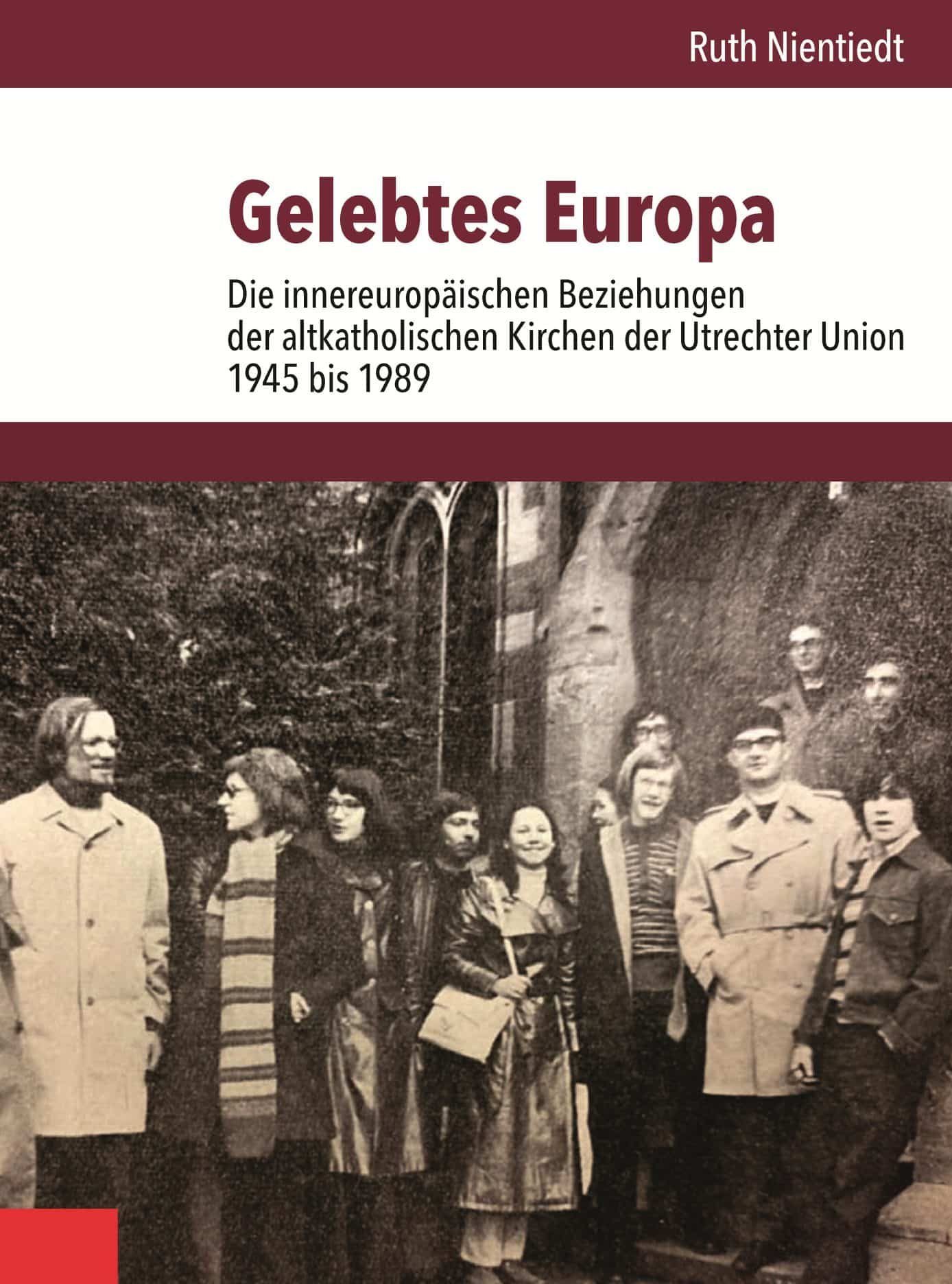
Mainz, 12 August 2026 – How did Europe emerge beyond politics and economics? In her new study, historian Ruth Nientiedt demonstrates that ecclesiastical networks also contributed to the transnational integration of Europe. Using the example of the Old Catholic Churches of the Union of Utrecht, she offers new insights into the history of European integration within civil society.
Despite political tensions and societal upheavals in the post-World War II era, the transnational ecclesiastical relations of the Old Catholic Churches persisted across national borders. All levels of church work—from organising international forums to establishing institutional structures and personal networks—contributed to maintaining civil society exchange and developing new forms of cooperation. Furthermore, key individuals from these contexts shaped intra-European relations over several decades.
Using three case studies, the author illustrates the role that Old Catholic networks played in civil society-led processes of European integration: The analysis focuses on the efforts of Czechoslovakian Old Catholics to establish closer contact with the Bishops’ Conference, the international work of Old Catholic women’s associations, and the transnational activities of Old Catholic youth organisations.
This multifaceted exchange encompassed ecclesiastical-political and ecumenical questions, as well as debates regarding the self-understanding of the Union of Utrecht and the role of women. Additionally, informal encounters, such as shared leisure activities like skiing or sailing, played a significant role in establishing and maintaining transnational relationships. Ruth Nientiedt demonstrates that these diverse forms of networking were grounded in the conviction that churches are called to cooperate, thereby contributing to mutual understanding, peace, and stability in Europe.
About the Author
Dr. Ruth Nientiedt is a member of the International Working Group for Research on Old Catholicism (Internationaler Arbeitskreis für Altkatholizismusforschung), a research associate at the Seminar for Old Catholic Theology at the University of Bonn, and the managing director of the Society for Christian-Jewish Cooperation in Dortmund (Gesellschaft für christlich-jüdische Zusammenarbeit Dortmund e.V.).
New Publication
New Publication: “Lived Europe: The Intra-European Relations of the Old Catholic Churches of the Union of Utrecht, 1945 to 1989” (“Gelebtes Europa. Die innereuropäischen Beziehungen der altkatholischen Kirchen der Utrechter Union 1945 bis 1989”). Publications of the Leibniz Institute of European History Mainz (Veröffentlichungen des Instituts für Europäische Geschichte Mainz), Volume 276, 1st edition 2026, 436 pages, hardcover, Vandenhoeck & Ruprecht, ISBN: 978-3-525-31180-6,
Open Access: https://doi.org/10.13109/9783666311802.
About the IEG
The Leibniz Institute of European History (IEG) is an independent, non-university research institute in Mainz. Its mission is the scientific research of European history. It fulfills this mandate through individual and collaborative projects of its researchers as well as those of national and international research fellows. The institute has been a member of the Leibniz Association since 2012.
Contact:
Press: Dr. Christian Eilers, +49 (0)6131 39 33635, eilers@ieg-mainz.de
Editorial Office (Lektorat): Dr. Christiane Kormann, +49 (0)6131 39 39397, kormann@ieg-mainz.de